Loading Jaywing website
25 November 2025 / News

The two signals we’re tracking as LLM Search evolves

Steven Cromb / Data Scientist

When conducting our LLM Visibility study of 200,000 prompts, we demonstrated that websites generally considered to have the best SEO were also the most likely to be referenced in LLM responses to topical prompts.

Since completing the study, we continue to analyse the data and notice that the pages being referenced are not always the same as those being found at the top of Google’s search rankings. This data builds a bridge between traditional SEO and effective GEO, showing where they align and, more importantly, where they diverge. To help you navigate that divergence, this blog outlines the two most important data points to start tracking.

The competitive landscape

Our study of 200,000 prompts showed that the top-ranking website in Google is also the most likely to be referenced in a related LLM response. However, this only occurs with a probability of around 46%. While this may seem low, it aligns with other recent industry studies that place the figure between 45-50%, suggesting this is the new benchmark for LLM Search performance. However, this is just the average across the whole dataset. When we dig deeper, the data gets more interesting. Traditional SEO will get you to the starting line in LLM Search but doesn’t necessarily win your brand LLM Search dominance.

In some industries we found a clear and dominant winner, similar to what can happen in Google Search. Crucially, this dominant brand is not always the same one ranking number 1 in Google Search.

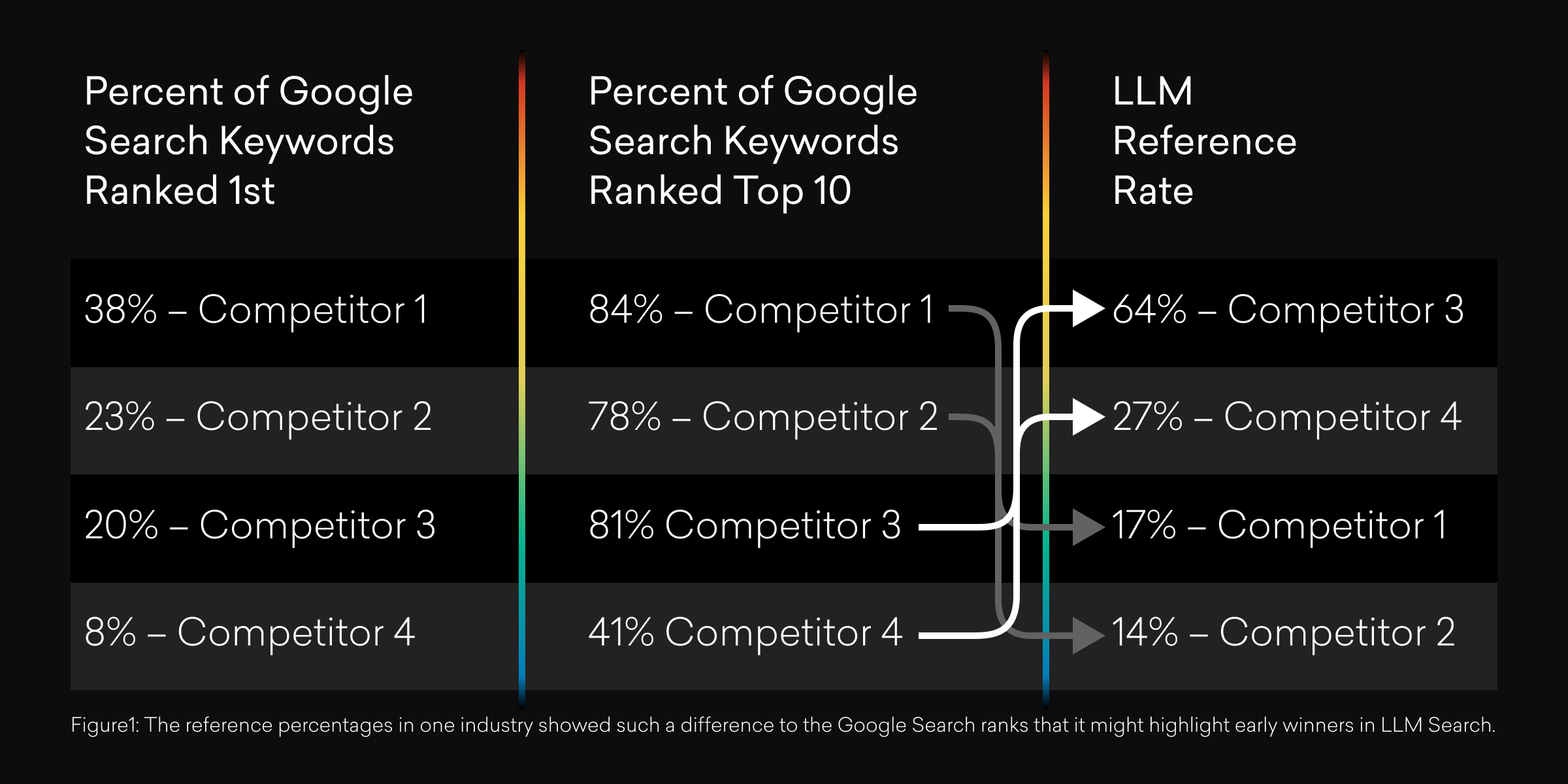
For example, we saw some websites being referenced in over 60% of LLM responses – a rate more than 10% higher than the average for a top-ranked site. These “early winners” were achieving this dominance without being the clear favourite in traditional search rankings (as shown in the diagram).

Figure 1: The reference percentages in one industry showed such a difference to the Google Search ranks that it might highlight early winners in LLM Search.

This is the key takeaway: LLM dominance is a new and entirely winnable metric. It's correlated with traditional SEO, but as the data shows, the winners are not always the same. Tracking the LLM reference rate for your brand and your competitors is now the best way to identify the patterns that define success, learn from the early winners, and build a strategy that works for this new search environment

The pages being referenced

A deeper analysis of our findings reveals another critical difference between Google Search and LLM Search: the webpages themselves. We compared the URL paths of top Google results against those cited by LLMs. Beyond the homepage, which remains the most common page type¹, a clear pattern emerged in favour of informational content, highlighted by the prominence of one URL path in particular: /blog/.

Our data shows us that /blog/ is the 17th most common URL path feature on the first page of a Google Search. Above /blog/ sits a large number of product category pages, categories such as /property/, /mobiles/, and /motoring/, indicating a preference for pages angled towards sales and conversions.

Our LLM study flips this on its head, with /blog/ appearing as the most common URL path feature, demonstrating the dramatic difference between what Google Search is surfacing for users and where LLMs are getting their information.

There are many possible reasons for this. The structure of blogs and content pages may be easier for LLMs to absorb and regurgitate to users. The types of questions the public are asking LLMs may simply require more evidence-based answers as opposed to leading straight to products. Whichever reason is true, your brand has a huge opportunity to identify and track the features that are showing up in the coming months. They may demonstrate changes to the way LLMs are being optimised for public use, and potentially how the companies running the LLMs are responding to commercial pressure placed on the LLM industry.

Your Strategic Takeaway

In the new era of search, unpublished expertise is invisible. LLMs can only cite the information they can find, which means even the most knowledgeable brands will be ignored if they are a "silent expert." The two signals we've tracked - dominant brand share and the rise of informational content - point to one conclusion: now is the time to translate your internal authority into public-facing evidence.

To start this process, ask your team two critical questions:

  1. Who is acting like the go-to authority in our space?

The answer, as our data shows, is not always the traditional market leader. It's the brand that is most consistently and clearly making the effort to publish expert content. This is your new competitor for AI visibility.

  1. Is our expert content built to be the answer?

If LLMs are prioritising blogs and articles, then this content is no longer just "top-of-funnel." It is the new front door for your most engaged customers. It must be treated, and funded, as a core strategic asset designed to own the answer for your industry.

Answering these questions is the first step to capitalising on a rare strategic opportunity. LLM search is a new and winnable domain, but this window won't be open forever. The brands that stop being the 'silent expert' and start owning the answers today will capture valuable market positioning for years to come.

Curious about where you stand?

We're offering a limited number of complimentary sessions for brands who want a clearer picture of their visibility in AI search. It's a chance to chat with our experts, see what the data says about your industry, and identify some practical next steps.

If you'd like to be considered for one of these conversations, please let us know by registering your interest below.